
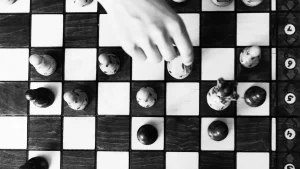
Scenario planning has a lot in common with how chess players approach their game. Research has shown that chess masters don’t approach a game with a master plan that they rigidly execute. Nor do they just react to the moves of their opponents. Rather, they are adept at “reading” the board at each stage of the game and hypothesizing their opponent’s likely near-future actions, and then planning accordingly.
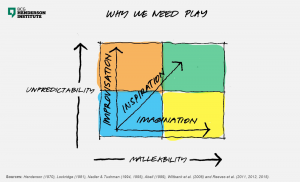 Inspiration is the other strand that runs throughout genuine play. The mental skill here was defined by the philosopher Aristotle, who pointed out two bad extremes in discussions: being too serious and dull, and being too frivolous — which is dull in its own way. In between these two lies a mental quality Aristotle called eutrapelia, or ‘good-turning’: being able to change direction playfully from serious to fun and back, engaging others in a rich but also light-hearted discussion.¹⁴ Somewhere between the t